A chronological history
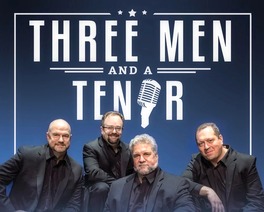
Almost 35 years of THREE MEN and a TENOR
It started with a scheduling problem and a two-week deadline. Nobody could have predicted it to still be going in 2027.
The beginning
It was January of 1992, and there was a problem — and an opportunity. The MSU Men’s Glee Club and the MSU Jazz Band were booked to perform together at a concert in Grayling, Michigan. But only a few weeks before the show, the Jazz Band got an offer to play in Chicago on that same date, which created the Glee Club opportunity. The MSU choir director offered that if anyone wanted to form a group, sing a solo, or play an instrument, they would be auditioning within days of the announcement to help fill that concert time. He was nervous that with only two weeks to prepare, only a select few would make it to the show. That opportunity created the formation of Three Men and a Tenor, when four members decided to take a leap of “fate”.
Three big guys and a little guy — “at least we would look funny”
Paul and Glenn, who at that time were sitting alongside each other in the first tenor section, decided to form the group. They asked Chuck to be the front man, and he agreed. Then, as the time until the concert ran out, they asked another bass singer to join, and as fate would have it, he declined. With Paul being 6′4″ and Chuck at 6′3″, they realised that if they asked another tall guy — regardless of his natural vocal part — then at least that would look funny. So they scanned the room and saw that Mark was the next tallest guy in it at 6′5″. When Mark agreed to do it, THREE MEN and a TENOR was formed — without ever having sung a single musical note together.
The name came quickly. It fit the description of the guys as well as the vocal parts. Over time it would prove a challenge to promote, since it has always made radio, television and record label executives pause to wonder whether the group is rooted in jazz, barbershop or opera. But once people started seeing the group live, the name was the perfect representation of who they were becoming, and so it stuck. As they approach their 35th year together, a name change is highly unlikely at this point.
Are we in this for the long haul?
The group had rehearsed and performed for only six months before life started factoring in. Paul was offered a full-time job in the machining industry at a sheet metal fabrication shop in Detroit and moved to the D in the summer of 1992. Chuck, Mark and Glenn were still finishing at MSU. During the group’s first year together the guys made an effort to keep rehearsing and do as many shows as possible, with Paul making the trek back and forth to East Lansing regularly. He was a regular guest on Chuck’s couch and would often leave for his job at 5am from East Lansing, tired from the drive but motivated by the shows and the direction of the group.
“We need stuff, and we don’t have any money”
One of the early business decisions the group made was to set up a toll-free 800 number so that it would not cost people money to book the band. Soon after came the decision to obtain Shell fleet gas cards so that getting to shows did not cost the guys their own money. Any additional show fee was invested back into the future of the group — wireless microphones, speakers, mixing boards, mic stands, other sound equipment, promotional items, and a company vehicle to carry it all.
It was three full years of shows before the guys ever individually took money from a performance. All money earned was reinvested in the equipment and promotional items necessary for growth. This commitment cannot be overlooked by bands trying to get off the ground. By doing it this way, the group grew to where they looked and sounded like a full-time band — and soon after, things began to confirm that decision.
A huge Spartan help: President Dr. Gordon Guyer
During MSU’s spring break in March of 1993, Interim President Dr. Gordon Guyer and his wife, Norma, were doing alumni visits in Florida. 3MT timed their spring break trip to align with those visits so that they could be the featured entertainment. The shows were very well received, and Dr. Guyer became a big part of the group’s next major steps. That spring, at MSU events all over campus, 3MT was featured and supported by President Guyer and his wife. That summer, at a major Spartan event in Charlevoix, 3MT was the headline act, and soon the phone began ringing because of that exposure.
In addition to helping with exposure, in a major show of support the Guyers gave 3MT a personal cheque to help fund the creation of their first recording, with no timeline for repayment. It was a very touching gesture from very important people at the helm of a major Big Ten university.
Too many shows to be part-time, not enough money to be full-time
Chuck moved to Dexter in the summer of 1994, putting both Paul and Chuck in the metro Detroit area, with Mark and Glenn still in the Lansing area. Those are still the two areas where the four members live. Following a commitment to each other to follow this musical path wherever it led, Chuck began his leadership role in booking the group with a full schedule of shows, featured appearances and media appearances, which helped increase their name recognition and bookings.
By the summer of 1995, just three short years after their formation, there was enough work on the schedule to consider making Three Men and a Tenor a full-time music career. Each of the four “real” jobs was not quite enough to keep the guys from doing music full-time, and the show schedule was starting to jeopardise their ability to keep that employment anyway.
The group goes full-time
Officially, in October of 1995, 3MT began their full-time touring schedule. The group ramped up fast, quickly totalling as many as 250 shows in one year, proving that there was an audience for their shows if they could coordinate them all.
Schools and the community concert
Chuck’s first full-time job out of college was working for QSP, a school-fundraising division of Reader’s Digest. In his sales capacity he started to offer schools a way to use the QSP fundraisers to bring in Three Men and a Tenor for school performances as a prize for reaching their fundraising goals. And it worked. It created school performances throughout lower Michigan, and the more schools 3MT performed for, the more opportunities it created in other districts.
This formula of daytime shows for the schools soon added a critical piece: the nighttime concert. Communities would bring 3MT back about two weeks after the daytime performances. The nighttime shows were presented by the choral and band music boosters at those schools, and in return for their partnership in selling tickets, 3MT gave those programmes a split of the door proceeds as an additional fundraiser. It proved to be a winning combination for over ten years and helped create hundreds of new performance opportunities.
Omni Arts in Education: shows in inner-city Detroit schools
3MT was hired in 1995 by Claudia Rogers and an arts outreach programme sponsored by Omni Hospital called Omni Arts in Education, to perform a vocal music show in inner-city Detroit elementary schools — some in the most economically challenged neighbourhoods in the city, often with boarded-up or burned-out houses within blocks of the school. These were 100% free and reduced lunch schools.
As anyone might expect, the moment 3MT took the stage there were looks of surprise and wonder on the faces of the kids. It did not take long for the musical connection to be made, and soon any barrier was crossed when 3MT got the kids laughing and the teachers dancing, performing the music of Motown and other fun music. For digging in and doing their part, 3MT became one of the most sought-after shows on the Omni Arts roster, and in 1998 they received the Spirit of Detroit award from the Detroit City Council for working to keep music alive in the Detroit Public Schools. It was an award that meant a great deal to the group — they made a musical connection to a great many young people, and proved that music is colour-blind.
Mike McLemore, the Sound Doctor
Not long after they began their full-time schedule, 3MT was at a featured performance in Adrian, Michigan when they met Mike McLemore, who was running sound and tech for the festival. Mike was the owner-operator of The Sound Doctor, a full-service sound, light and tech company with twenty years of production experience and enough equipment to provide full PA support and lights for any of the upcoming performances. The two companies formed a collaboration, and 3MT had full sound and light production at every show, enough for just about any size venue in the country. The partnership also brought the combined use of his office staff for bookings, contracts and scheduling, so the group could focus on a full schedule and bigger shows.
The vocal coaches and managers
As the group got more and more shows, the need for management became evident — and the need to improve and maintain the voice was critical. Marsha Lyttle was a small business marketing and management specialist who brought her expertise to the promotional pieces the group sent out for bookings. Cheri Gapinski and Sherry Miller were brought in as vocal coaches to keep the guys on course for new songs and arrangements, and using proper technique to sustain the voice on long tours. Those years of preparation paid off as the number of shows increased. All three played a big role in pushing 3MT to be better. Cheri Gapinski died in the autumn of 2017.
Paul Cooper — the group starts dancing
In 1998, at the Contemporary A Cappella Society of America summit in Boston, 3MT met Paul Cooper, lead singer and founding member of The Nylons, the platinum-selling and Grammy-nominated pop a cappella group from Canada. Paul had been on national television, in major recording studios, and had earned industry respect as a professional singer and songwriter — all skills 3MT could lean on to learn the stagecraft for bigger vocal music shows. His experience in production and showmanship transferred over perfectly, taking 3MT from four guys standing in one area singing to a polished, choreographed, stylised vocal music experience.
Paul passed away peacefully in his sleep in December of 2013. His impact is still felt in the shows, and in 3MT videos on YouTube you can sometimes hear Paul’s voice in the count-offs.
The national PBS-TV special
This new team of Three Men and a Tenor and Paul Cooper went on to produce the Listen to the Music and You Better Watch Out CDs, and then worked for eighteen months to prepare for taping a PBS television concert special with WCMU in Mt. Pleasant. When the funding for that first special fell through, the group pitched their performance to the executives at Detroit Public Television in late 2002. DPTV knew 3MT had a following in Michigan, agreed to produce the show, and promoted it nationally.
In April of 2003, DPTV filmed and produced a 90-minute concert special, Three Men and a Tenor — In Concert, taped in front of a sold-out crowd of over 1,700 in Dearborn. The show eventually played in over 70 major and smaller television markets across the country and was awarded an Emmy for Best Live Shots. One of the major successes of the taping was that it was recorded live to tape, meaning they would only stop in cases of major production flaws. Amazingly, the group filmed their 90-minute show in one take, with no retakes needed. It was a statement about how prepared they were for their big opportunity.
Two U.S. military base tours in Germany
In 2004 and 2006 the group was contacted by Marty Benstein, a vocal music teacher at a U.S. military base in Germany with connections across the country that could help him put a tour together. When 3MT enthusiastically replied that they were ready, they found out it would not be that easy to get there — funds were limited and costs were high. Fortunately the group had built up corporate support along the way, and received sponsorship from GM’s Foreign Car Exchange for the 2004 tour, and from the Daimler Chrysler Corporation Fund and the Downtown YMCA of Lansing for the 2006 Freedom and Families tour.
Marty booked two complex tours, taking care to promote and inform the families on the bases of just what 3MT could do to lift their spirits. He coordinated 23 shows in 12 days in 2004, then 38 performances in 16 days in 2006. As an unplanned part of the tours, the guys also made stops at Landstuhl Hospital in Ramstein to sing at the bedsides of wounded American soldiers. Those moments were heartfelt, and the group has said their lives were changed by talking with the young men and women just off the battlefields of Iraq and Afghanistan.
Marty lost his battle with cancer in 2009, but his love and support for 3MT will never be forgotten, and the group remains in communication with his wife.
Music and laughter heal in hospitals
Singing at the bedsides of wounded soldiers led to an unexpected next chapter. In 2006, Gerard VanGrinsven, former CEO of the Ritz-Carlton in Dearborn, became CEO of the Henry Ford Health System in West Bloomfield — a campus that set out to change the boundaries of the imagination of health and wellness. He had previously hired 3MT for corporate entertainment at his leadership symposiums. For the new health system he wanted the group to do something no other Henry Ford hospital had done: make a singing group a regular part of the healing process. He knew 3MT had done exactly this in Germany. The group made three or four visits a month to patient rooms, and the relationship lasted over six years.
National television auditions
Around 2010 it became a regular comment after performances that 3MT should go on the televised talent competitions. In 2011, having won Mid-Michigan’s Got Talent, they auditioned in New York City in front of the directors and producers of NBC’s America’s Got Talent, and in Chicago for The Sing-Off, making it through the initial audition phase in both cases and impressing the producers with their talent and showmanship. Neither passed them to the next round. The guys were disappointed not to make it on to national television, but knew it was not the end — just part of the journey.
Opening for national icons
As of 2026, 3MT has almost 4,000 performances and has been seen live or on television by an estimated three million people. The group has opened for American entertainment icons including:
Comedians
Jay Leno · Bob Newhart · John Pinette · Soupy Sales
Musical acts
The Beach Boys · Lee Greenwood · Peter Cetera · Chuck Berry · .38 Special · Dionne Warwick · Mitch Ryder
Awards and honours
- Best Entertainment in Lansing (2025) — Community Votes Lansing
- Best Live Band in Lansing (2025) — Community Votes Lansing
- Best Entertainment in Michigan, four times — MI Meetings and Events Magazine
- Highest-Rated Touring Group (1996) — Michigan Arts and Cultural Affairs
- Entrepreneurs of the Year (2000) — Greater Lansing Business Monthly
- Spirit of Detroit Award (1998) — Detroit City Council
Donny Brown and 3MT
3MT recorded 3MT25 with producer Donny Brown, who brought great vocal arrangements to the record and serves the music with unique ideas and interesting vocal twists. As the guys enter their 35th year together, 3MT25 represents a sound that is the best of 3MT while keeping the original blend and emotional delivery you have come to expect.
The people who made it possible
Over the years, with countless shows and projects, 3MT has gained lifelong friends and supporters who pitched in their services and made remarkable contributions. This is a partial list of many more, in no particular order.
- Dr. Jefferson Johnson — MSU Glee Club director who created the opportunity for 3MT to form
- Dr. Jonathon Reed — MSU Glee Club director who allowed 3MT to perform past their first year
- Kurt Thoma — tech manager, road manager, equipment manager, driver, scheduler, problem solver, rock
- Gary Bender — legal support for the PBS special, recording projects, licensing and copyright
- Dorothy Genoe — office manager, administration, bookkeeping, scheduling, angel
- Kirk Squiers — consultant, financial supporter, project manager, tech manager, tour manager, printing
- Andrew Harmon — sound and light tech manager, road manager, equipment manager, Arizona tours designated driver
- Johnny Burke — radio DJ, the voice of the 3MT show intro, a great friend of the group
- Ken Calvert — one of Detroit’s most respected DJs, had the group on WJR 760AM many times. RIP, 2024
- “SuperFan” Nan Manley — financial supporter, tour companion, loving 3MT grandmother. RIP, 2015
- Rod Bushey — choral director at Howell Public Schools, deeply involved with booking 3MT and working with his choirs
- Lucy Ann Lance — Ann Arbor DJ, booked 3MT on her radio show several times
- Tom Pastotnik — chief graphic designer, web designer, tech help, social media manager
- Todd Fisher — YMCA director and supporter of the Germany tours; booked four annual YMCA concerts at Wharton Center
- Jeff Hayes — lighting and stage production manager
- John Dale Smith — coordinated the “4x8” group combining 3MT with J and J Sounds for two big Lansing concerts
- Evan Arhangelos — printing director, project manager, booking agent, support
- Judy Hutchinson — web design and development
- JD Small — promotional photoshoots that captured the fun of the group
- Bill Drake — first official business manager of 3MT in 1995, and road crew
- Bill Ayars — merchandise manager and tech crew on both tours of Germany
- Terry Grady — early-stage booking agent and business consultant
- Steve Thelan — Michigan Fairs and Festivals committee member and director of the Saline Community Fair; helped hire the group five times
- Ryan Tryczinski — technical support on the road and at performances for over 25 years
And there are hundreds more who have helped and offered guidance over the years. Thank you.
Thank you for the love and support
Almost 35 years. Ups and downs. Fights and fun. Marriages and children. Old cars and equipment trucks. Two years of surviving a global pandemic after eighteen months without a single show booking. Somehow, still making it all work. Same original founding members. The same simple goal of making people feel better through a couple of hours of musical interaction and laughter.
See a show and see what so many have enjoyed over the years, and expect that you will feel better — it is an experience that you can’t help but want to bring others to enjoy as well. For how many more years, who knows? For now, you should catch it while you can.
Bring the 35th season to your venue
Booking 2027 and 2028 dates now.